
My disclaimer always says that my articles are written by a human, and humans have been known to make mistakes from time to time. Point me to where I’ve gone wrong, with good references and analysis to change my mind, and I will gratefully edit my work- and my mindset too. I actively try, though not always successfully, to care more about getting the issues right, than about being right myself.
A reader suggested that I might give examples of where I’ve been wrong and had to change my mind. While nobody would read such a long tome- and I might not survive writing it either- listing a few examples of where I’ve been wrong and had to change my mind, might be useful to some. And self-reflection something I’ve always found essential anyway, so writing this will be useful to me too.
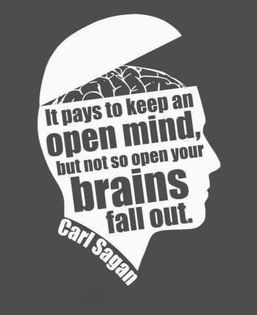
It’s important to have an open mind, but as Sagan said, not so open that your brain falls out of your head. And especially not so open that people can take a dump in your skull and fill it with disinformation.
It’s also critically important to realize that most ideas- including most of your own ideas- are worthless. I do my bit for the environment by composting most of my ideas, hoping that something worthwhile will grow out of the resulting humus.
A warning: this piece won’t focus only on technical topics. It’ll go a bit deeper, into the world of values where by definition we will not all agree- because that’s where the most poignant examples are to be found.
Hydrogen as a Fuel
In my youth, it seemed obvious to me that we’d need fuels in the future, and that when fossils ran out, which they clearly would one day, we’d need to burn hydrogen made from water using nuclear power.
As climate change risk became a more obvious reality, that option- making hydrogen from water to burn as a fuel- seemed more and more obviously necessary in the future.
I’ve changed my mind on that entirely. Building small reformers for Texaco and later Chevron, intended to make fuel for fuelcells first for vehicles and then later for combined heat and power in homes, forced me to contend with hydrogen’s immutable, intractable problems as an energy vector. In the decades since that work, my extensive experience making and using hydrogen and syngas, and with developing and scaling chemical process technology, has reinforced this conclusion.
Hydrogen made from electricity, will never be cheap enough to waste as a fuel. Virtually everything that hydrogen can do as a fuel, electricity can do better on its own. And those few applications where we’ll need liquid fuels in the future for decades (aviation and shipping for transoceanic distances), will not use fuels made from their combustion products using electricity.
I’ve written about this extensively, but here’s the most positive of those articles, which focuses on where green hydrogen “fits”, rather than shitting on all the bad applications that interested parties have been pitching hydrogen for, trading one drug (#hopium) for another (#OPM, i.e. other people’s money).
https://www.linkedin.com/pulse/where-does-green-hydrogen-fit-paul-martin-oc8ac
Nuclear Power More Generally
I once believed that nuclear power was the only alternative for electricity generation, once the obvious hydropower had been as fully exploited as the environment would allow. Then again, to be fair, I thought that in the 1980s and early 1990s.
But I’ve changed my mind about nuclear- a couple times.
Nuclear offers low GHG power and can be made adequately safe. Its construction in my home province of Ontario, saved hundreds of thousands if not millions of premature deaths by ending the combustion of coal. There’s lots positive to say about nuclear.
But I’ve since learned that nuclear is economically inflexible to demand. Nukers are all capital cost and operating costs that exist regardless of whether the unit is running or down- their cost of fuel is trivial in comparison. The only way you can afford nuclear power is therefore to run the plants as near to 100% capacity factor as possible, to spread their enormous capex over as many kWh as possible. So while you can modulate the output of a nuclear reactor, few ever do, for reasons of cost and cycle life on the extraordinarily expensive equipment involved. In Ontario, for instance, capacity factor is in the 92-94% range for units that are not down for extended periods for refits. The 6-8% of unrealized capacity arises from outages or maintenance, rather than operating at less than 100% output.
Realistically, nuclear is only suited therefore to the very base of baseload demand. If you build nuclear reactors with more capacity than to produce the lowest hour’s demand throughout the year, you’re wasting money, and not small amounts of money either. Worse still, you need to predict that lowest hour of demand at least ten years in advance. Either that, or you need to build storage. And once you have storage, wind and solar eat a good chunk of your prepaid lunch.
Here’s the only article I ever intend to write about nuclear power. It’s about the scaling-related myth of small modular nuclear power plants- a delusion that will never become a reality.
https://www.linkedin.com/pulse/scaling-examples-pt-1-small-modular-nuclear-reactors-smnrs-martin
Biofuels
I once thought that biofuels had a decent shot at competing economically against expensive petroleum when it is properly burdened with a carbon tax. I figured that surely, when petroleum ultimately ran out, we’d need to gasify biomass and use Fischer Tropsch to make the hydrocarbons we’d need.
Decades of hands-on work with biofuels, however, has convinced me that we can only count on using them for the last resort applications which need, rather than merely want, liquid fuels- transoceanic aviation and shipping. And hands-on experience with F-T, taught me that it is actually an acronym for “f*cking terrible”, or “fundamentally terrible”- actually, both at the same time.
We can use biogas methane, stored in the existing fossil gas infrastructure, for dunkelflaute and emergency response power generation, assuming we think that’s a good investment relative to just burning unmitigated fossil gas for ~ 5% of our energy needs.
Everything else- substantially all land transport for instance- is going electric.
https://www.linkedin.com/pulse/short-screed-biofuels-paul-martin-y7ohc
Environmentalism
I’ve always considered myself to be a pragmatic environmentalist, and still do. But my attitude toward environmentalism has matured considerably since my university days.
My first jobs after graduation were related to environmental remediation- cleaning up the sins of the past, after the fact, which I figured was the only real way to be a serious environmentalist as a chemical engineer. It didn’t take much experience with the difficulties of “end of pipe” type solutions- including hands-on experience with pointless battles against the 2nd law of thermodynamics- to realize that the real effort to make the world a better place, is best expended at the front of the pipe.
Fortunately, I learned that lesson young enough that I have actually spent most of my career dealing with what goes into the pipe rather than what comes out of it, post dilution!
You can imagine, therefore, my attitude toward direct air capture- the idiot cousin of carbon capture and storage.
https://www.linkedin.com/pulse/why-direct-air-capture-sucks-good-way-paul-martin
I continue to be more than merely skeptical of “doomers”- people who think that humans are a “cancer” and that there are no solutions possible to the environmental problems that humans are creating- that all technological solutions are a delusion. While I have some sympathy for people who despair at the extreme harm that humans have done and continue to do to the natural world, I think that anyone who loathes their own species to the point of calling it a “cancer” should be given a wide berth and their ideas- on environmental matters at least- should be treated with considerable suspicion. I similarly have no sympathy and give no credence to people who use real concern over anthropogenic global warming or other environmental harms, as a cudgel to bring about ideological objectives they have failed to bring about by political means- ending capitalism, or ending the eating of meat etc. I no longer consider such people to be allies in the fight against climate change.
Waste is Always Wrong
I am a scavenger and salvager at heart- I come by that honestly by nurture and I believe it also suits my nature. I treat other people’s cast-offs as my inputs as often as I can manage. I also am a campaigner for efficiency, because all inputs of matter and energy have environmental, social, political and economic impacts that make thrift and efficiency a worthwhile default policy. But whereas I once believed that almost everything that was a waste, could and indeed should end up as a feedstock or source material to somebody or some process, an education in the 2nd law of thermodynamics has made me realize that we should stop talking about the “circular economy”, and instead talk about optimal recycle. And while the optimal recycle is never 100%, it is often zero. That leaves us with a different decision: is the benefit from that single use, worth the impact?
I have no less right as a human, to use the resources of the earth to meet my needs, than any human who has ever lived or who will ever live- we can have a long philosophical discussion, over beers or something stronger- about just how much I deserve to use to satisfy my whims and wants- to make art for instance- but we are unlikely to come to a uniform agreement on that, as our values likely differ. One thing however is certain: as our energy systems become cleaner and lower in emissions, the optimal recycle rate of many things will increase- some rather dramatically. Our focus should therefore remain on cleaning up our energy supply, and using that energy wisely rather than in vain attempts to reverse thermodynamics.
https://www.linkedin.com/pulse/circular-economy-thermodynamic-myth-paul-martin-9nfic
I’ve also realized that my time on earth is a finite resource too- and one which I can’t justify spending more than a certain amount of, in the pursuit of keeping old, worn out shit running and functioning properly. As the son of a mechanic, I took pride in driving old rust-buckets- generally small ones which got good gas mileage, but still, cars whose next destination was the scrapyard. I got lucky with a few of them too. I always thought that anyone who bought a new car was as sucker, as that depreciation the second the keys touch your hand was just an expenditure that could very easily be avoided. But after a used car nearly ended my honeymoon in divorce, I bought my first brand new car. When I drove that new car in to work, I had numerous colleagues feel my forehead for a fever, and ask who I was and what I’d done with Paul Martin…I’ve learned that things I’m going to use more than trivially, I am better off to buy new and maintain myself, than to trust in the risk of buying used. Of course that isn’t a hard and fast rule- I do owe my current career to a great hobby project- electrifying a 1970s car which I owned out of love rather than reason. But even there, I learned that trying to cure multi-metastatic car cancer is a fruitless exercise. If you’re going to do a conversion, start with a clean “roller”- don’t waste your time on rust buckets!
https://www.linkedin.com/pulse/e-fire-triumph-spitfire-ev-paul-martin
Arguing with Climate Change Denialists
I was dead wrong here too. I used to think that abandoning the discussion to climate change denialists was a bad strategy, as it left undecided bystanders at risk of being convinced that the loudest and most persistent voices were the right ones. Now I know better: when a denialist presents a denial or climate minimization argument, I call them on it, post a copy of my article on the solid evidentiary basis behind climate change for the bystanders, and then block the denialist and move on. I don’t allow my comments or posts to become platforms for their disinformation, nor do I draw my followers’ eyes to their nonsense.
https://www.linkedin.com/pulse/global-warming-risk-arises-from-three-facts-paul-martin
It is critical to realize that a position which has been arrived at without recourse to data, logic and analysis, cannot be changed by data, logic or analysis. People so deep in confirmation bias and in-group membership to believe, in this day and age, that climate change risk isn’t real or isn’t serious, are simply lost. The planet will bury them eventually and humankind will move on.
Belief in the Supernatural
I was raised a Catholic, and while Catholic school eventually did a number of any straightforward Christian belief I held, for a long time I was convinced that there was some kind of transcendent reality that made human life and consciousness make sense by giving it some kind of transcendent meaning. Sure, a native sense of ethics made it obvious to me that hell was a bullshit human construction, and that good people who weren’t Christians couldn’t possibly go on to eternal torment at the hands of a loving god (and by the way, if you don’t believe this, you aren’t a Christian any more, regardless how you think of yourself!).
Over time, after much reading and learning and experience of the world as it is rather than as I’d have liked it to be, I went from full-on theist (believing there was a god who responded to prayer, and a get-out-of-death card called heaven if not the lake of fire for the damned), to deist (i.e. the universe is god), to atheist. In fact, I’ve tried my best to get rid of all beliefs I hold on the basis of either poor or entirely absent evidence- the last god just went along with all the others, plus lots of other stuff. The sooner we realize that the world doesn’t reward virtue or punish vice, and that bad things happen to good people every day and vice versa, the sooner we’ll be fully adult and properly compassionate toward one another.
All that said, I do have more than a passing fancy for the Flying Spaghetti Monster- a god who is too dumb to intervene meaningfully in human affairs except to have a laugh from time to time, and too drunk to care, does explain a lot about the universe as I’ve observed it so far.
Be Willing to Change Your Mind!
Confirmation bias is a real thing, and the internet is the perfect tool to reinforce it. It’s very easy to become locked into a world view that is self-reinforcing- one which also often comes with a sense of community which we humans seem to long for as social creatures.
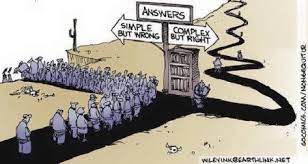
“Every complex problem has a solution that is clear, simple and wrong”- H. L. Mencken
I’ve come into this world with some key advantages that some very smart people lack: a willingness to be disagreeable, a functioning and undamaged cognitive dissonance detector, and a keen nose for bullshit (one that hasn’t been fatigued by constant exposure). People’s desire to get along, to not cause a stir, to not question because it might reveal ignorance or might provoke a reaction from authority- is one of the most dangerous tendencies among humans, because it is ripe for exploitation by malevolent people. And if you think there’s some good in everybody, you’re simply not meeting enough people! Groupthink leads to the incineration of billions, the wasting of lives, and delay to real progress.
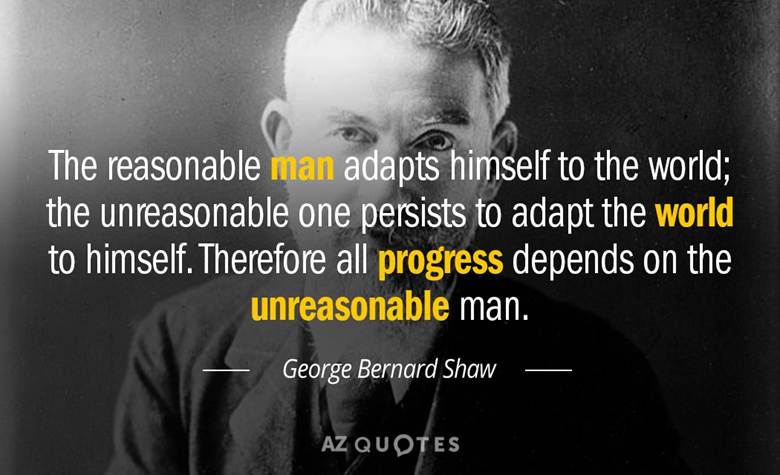
It can be very challenging to abandon a world view that is not in fact supported by the evidence, to admit you were wrong, and to move on to a greater understanding. I’m very far from perfect at this, but I do at least make a very conscious effort to try! And a big part of that, is the well reasoned, well supported argument of people who read and comment on my articles and posts on LinkedIn. Some of them have even become real friends- sometimes real friends who I may never meet in person.
My Personality is a Weakness
In fact, certain people had me convinced that my personality- who I truly and naturally am- was a weakness that I needed to work on. If I could only learn to get along, to hold my tongue, to suffer fools and foolish ideas gladly etc., I’d be easier to promote and more successful in business. And that was likely true! But where I went wrong, was in believing that the people who were offering this advice, were doing so in my own best interest rather than in theirs. In reality, they wanted me to be easier to control, and to ignore when it suited them.
When I went into business for myself, I really started liking my boss. We do still get into arguments from time to time, and have to take one another out for a drink so we can have it out and come back of one mind on the subject! But I also realized, like Popeye, that “I yam what I yam and that’s all I yam!”. What I really needed was to be able to use my natural tendencies toward truth-telling and to sell it as a service to people who are tired of being fed a line of bullshit- people who are betting their money and their effort on things that have to be right. People that need help cutting through the natural tendency to fall in love with an idea and then to lack clarity about it. Since I started playing to my own strengths, rather than trying to make myself into a poor copy of what someone else thought would suit their own interests, I’ve never been happier- and my independent consultancy has thrived. So when you visit www.spitfireresearch.com, you’ll find that one of our products is described as follows:
No Bullsh*t: We call a spade a shovel, in the interest of clarity and to save you time and money. If you’re looking for someone to flatter you and buoy confidence in your precious new idea, you probably should look elsewhere. But if you want clear, direct, no-bullsh*t advice about process development and decarbonization matters, you’ve come to the right place.
And finally: as a recovering #hopium addict myself, I suggest that we all smoke less #hopium. Sober people are more likely to make sound decisions- and more likely to be correct on matters of great importance.
https://www.linkedin.com/pulse/what-hopium-paul-martin
If you found this interesting, here’s a link to all my articles. And if you want to help, and to motivate me to write more, the best way you can do that is to share them so that others get a chance to read them.
https://www.linkedin.com/pulse/links-all-my-articles-paul-martin-6gxxc
Written by a human, who tries to care about getting things right more than about being right personally- without the assistance of automated plagiarism software (AI).