
31/10/26
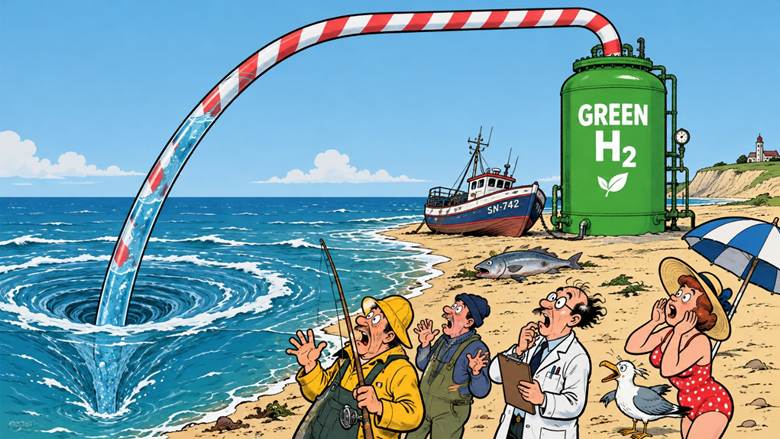
TL&DR Summary: green hydrogen’s water use is not a meaningful environmental impact. Green hydrogen, if made truly green, may actually reduce water use when it replaces black (fossil derived) hydrogen for use as a chemical. Green hydrogen’s problem- and it’s a big one- is energy use, not water use- even when that hydrogen is not foolishly being wasted as a fuel. Those working on direct electrolysis of seawater or unpurified water are working hard on the wrong problems.
Water is a paradox: it is absolutely essential for life, and at the same time, it is a very low cost, low economic value commodity, used foolishly and in giant quantity for absolutely trivial purposes. Pure water is essentially a very low value form of stored solar energy, as solar energy distills it from the oceans and then deposits it again in lakes, rivers and aquifers.
People concerned about green hydrogen production, are often concerned about water use. A process which uses water to make a chemical, naturally deprives people of pure water that they might find valuable for other uses, so it seems logical to be concerned that a green hydrogen project might put strain on clean water resources in a particular area. This is especially concerning in arid regions where solar resources are excellent and land is cheap.
Beware the Nirvana Fallacy
It is important when looking at environmental issues, to not suffer from the nirvana fallacy. All alternatives must be compared against their real competitive technology, not against some imagined no-impact ideal. Nirvana isn’t on the menu, so adults must choose between alternatives, weighing their impacts against one another in accordance with their values. And since our values differ, we are not all going to agree on what’s best.
Use Cases Matter!
For hydrogen, there are two alternatives to consider, which depend on the use case for the hydrogen. If you’ve read any of my previous writings, you’ll know that I think wasting hydrogen as a fuel for any purpose, or to make fuels from inert materials like nitrogen or CO2, is a fool’s errand, irrespective how you make that hydrogen. So we won’t belabour that point: any water used to make green hydrogen that is wasted as a fuel, can’t be justified in my view because the whole premise of using hydrogen as a fuel is an economic and environmental non-starter.
https://www.linkedin.com/pulse/where-does-green-hydrogen-fit-paul-martin-oc8ac
The other use case is the replacement of those uses of hydrogen as a chemical in uses durable post decarbonization. 99% of such hydrogen today is made from fossils- gas, coal and petroleum- without carbon capture. By my very rough estimate, at least 90 of the current ~ 120 million tonnes of pure hydrogen and hydrogen in syngas that we make today, will still be needed when we’ve transitioned the entire world’s energy system away from the deliberate burning of fossils as fuels.
https://www.linkedin.com/pulse/hydrogen-from-renewable-electricity-our-future-paul-martin
Some comparison metrics between green hydrogen and fossil derived hydrogen are therefore useful in evaluating whether water use is a problem in green hydrogen production.
Steam Methane Reforming
For hydrogen produced by steam methane reforming, at least 4.5 kg of water are consumed chemically per kg of H2 produced. This water is fed as steam to the reformer and its hydrogen leaves as part of the product H2. Real SMR systems however are more complex. They consume water in the form of boiler feedwater preparation and blowdown, and also from evaporative cooling. Per this reference:
and several others, a mean total water consumption for SMR is about 20 L of water per kg of H2 produced.
Water used for once-through cooling, i.e. water withdrawn from a lake or river and returned to that same lake or river simply at a higher temperature, isn’t really “water use” of the same category as water withdrawn and then evaporated or consumed by the production process. Cooling water withdrawl of this sort may amount to perhaps another 40 L/kg of H2.
Coal Gasification
Coal is gasified by reaction with steam and oxygen, to produce synthesis gas mixtures containing H2, CO, CO2, methane and other gases. While no precise split is available in the literature, to a first approximation determined by inference from the available data, about ½ of world hydrogen produced from coal is used in the form of syngas (mixtures of H2 and carbon monoxide (CO)), used to make things like methanol, whereas the other half is used as pure hydrogen to make things such as ammonia. This split complicates water use estimations, because making pure hydrogen involves carrying out more water-gas shift reaction, converting more CO to CO2 by reacting it with water to make H2.
The minimum amount of water required is about 9 kg water per kg of H2 made from coal, but real coal gasifiers consume at least 49 kg of water and may withdraw between 50 and 80 L of water per kg of H2 for once-through cooling. Use figures vary greatly depending on the nature of the gasifier and whether it is fed powdered or slurried coal.
Petroleum Reactions
Roughly as much hydrogen is made from petroleum as is used to desulphurize and hydrocrack petroleum in refineries. Good estimates of water consumption for this highly integrated process, split between petroleum refineries and downstream petrochemical processes are difficult to come by, but it is safe to say that water consumption in net terms from these processes will lie somewhere between the extremes of methane and coal.
Electricity Production
Taking the USA as an example, each kWh of electricity produced results in the consumption of about 0.9 to 1 L of water in the form of evaporative cooling and boiler feedwater preparation/blowdown. A further 43 L of water is withdrawn and returned for cooling.
Green Hydrogen
Stoichiometry requires 8.9 kg of freshwater to be fed to an electrolyzer to produce 1 kg of H2 and 7.9 kg of O2. Real electrolysis units however consume more, in the form of water purification blowdown and other similar losses. Water consumption estimates range from 17.5 L/kg for PEM and 22.3 L/kg for alkaline electrolysis, including any water used for evaporative cooling. A further 14-19 L/kg of H2 are withdrawn for once-through cooling.
However, like there is no true Scotsman, there is no truly “green” hydrogen. While fully islanded green hydrogen made thousands of miles away from people who need electricity exists in theory, in practice most green hydrogen projects are grid connected and hence have at least some grid water consumption associated with the electricity they consume. Hydrogen production by electrolysis consumes between 50 and 65 kWh/kg, and it is easy therefore to realize that even a very small amount of typical grid electricity use would positively dwarf the water consumption per kg of H2 of the electrolysis process itself.
| H₂ Production Process | Water Consumed | Cooling Water Withdrawn |
| Steam methane reforming (SMR) | ~17.5 L/kg H₂ | ~13.6 L/kg H₂ |
| Coal gasification, with CCS | 49.4 L/kg H₂ total | ~65 L/kg H₂ |
| — Coal gasification: process/treatment water | ~15 L/kg H₂ | — |
| — Coal gasification: evaporative cooling + blowdown | ~34 L/kg H₂ | ~65 L/kg H₂ |
| Green hydrogen — PEM electrolysis | 17.5 L/kg H₂ | 14.4 L/kg H₂ |
| Green hydrogen — alkaline electrolysis | 22.3 L/kg H₂ | 18.0 L/kg H₂ |
| Green hydrogen — PEM to alkaline range | 17.5–22.3 L/kg H₂ | 14.4–18.0 L/kg H₂ |
| Electrolytic hydrogen using U.S. grid electricity | 69.8–74.6 L/kg H₂ | ~2,390–2,394 L/kg H₂ |
Sources: IRENA, Sustainability (2025), EIA, Spitfire Research estimates
It should be evident that just as for the GHG intensity of each kg of hydrogen produced by electrolysis, the water use depends very strongly on whether or not even small amounts of grid power are used to supplement renewable generation that is proximate and temporally matched to the electrolyzer. Grid electricity rapidly makes green hydrogen, rather black indeed, if for no other reason than the renewable electricity used to make that green hydrogen, could instead have been used to reduce fossil electricity production on the grid- a higher value environmental use, at a lower cost per tonne of GHG emissions averted.
https://www.linkedin.com/pulse/how-green-hydrogen-lifecycle-basis-paul-martin-pbhyc
Water Purification
Green hydrogen requires very pure water, to avoid wasting electricity on side reactions which produce molecules other than hydrogen and oxygen. These molecules, particularly chlorine species, can render the products impure, and may also destroy catalysts, membranes and other materials of construction in the electrolyzer. Accordingly, water used for hydrogen production must be produced by a process such as deionization or reverse osmosis. The water consumption associated with freshwater reverse osmosis is included in the estimates above- but it is also possible to desalinate seawater, brackish water or to purify wastewater using reverse osmosis to produce the necessary pure water feed to the electrolyzer.
And here’s where the energy consumption of hydrogen production by electrolysis, becomes rather obvious in comparison.
Reverse osmosis seawater desalination is seen as an extremely energy intensive process, whereas in fact, the opposite is true. Seawater desalination by RO consumes about 3.5 (2.5-4) kWh per m3 (1000 L) of pure water produced, relative to a thermodynamic minimum energy of separation of about 1.1 kWh/m3 of pure water (producing a waste brine stream of similar concentration to that typical of RO desalination). That’s on a whole system basis. At $0.10 per kWh, that’s $0.35/1000 L for energy, which is 1/10th of even the pittance that I pay to purchase bulk drinking water from the municipality near our farm. Very rarely do separations of fully miscible components, approach the thermodynamic minimum this closely. From this, we can see that RO is already a very well developed technology, and that the perception of its energy use is largely a result of how profligately we waste giant quantities of water without a 2nd thought. And while we can expect minor improvements in this process in the future, no future magical graphene membrane studded with buckyballs and carbon nanowires, nor any other magical foo-foo dust, will ever drop RO’s energy consumption by a factor of four or more relative to the current state of the art. Doing so would violate the laws of thermodynamics.
Even taking the entire 17-21 L of water per kg H2 used by electrolysis in total, including water used in evaporative cooling (something unlikely for projects next to the sea for instance), preparing that water by RO desalination would require about 0.07 kWh per kg of H2. Electrolysis, in contrast, consumes between 50 and 65 kWh/kg of H2.
The real problem with hydrogen production, therefore, even in the very worst case (seawater desalination), is energy consumption, not water consumption. Water purification is barely even within the noise of electrolyzer efficiency variation, and doesn’t amount to a significant fraction of the capital cost of an electrolysis-based hydrogen plant, either.
Need some freshwater? Then by all means- find a way to avoid wasting 1 kg of hydrogen. You’ll have enough electricity left over, to make at least 14,000 litres of freshwater, even by desalinating seawater!
Summary and Conclusions
We see this sort of thing all the time in the cleantech and renewable energy space, and in technology more generally. Lots of people latch onto a myth, and then expend considerable effort, time, and generally also large amounts of other people’s money, working on solving the wrong problems. That’s a waste of time, effort, money, and emotional bandwidth. A little time spent researching the issue and doing some very basic calculations, can avoid wasting huge amounts of time, effort and money on non-solutions like seawater electrolysis for hydrogen production.
Disclaimer
This article has been written by a human, without the aid of automated plagiarism software. While AI tools have been used to aid the gathering of references behind the analysis, AI frequently gave wrong results that had to be corrected by the intervention of the same human. So it is clear that both humans, and their AI tools, are capable of making mistakes from time to time. If you find something wrong with this analysis, please bring it to my attention with good references, and I will correct it with gratitude.
If however, what you don’t like about my article is that I’ve taken a dump on your pet idea, your PhD topic, or something you’ve invested in: then please! Contact my employer, Spitfire Research. They will be happy to tell you to piss off and write your own article.