
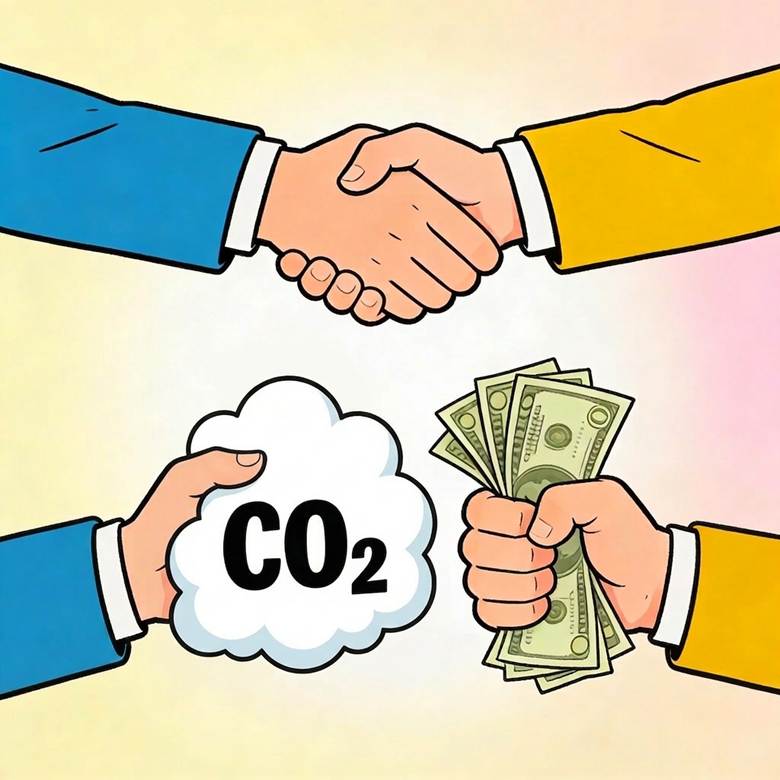
Image produced by generative AI, using the stolen works of millions of artists.
TL&DR summary: CO2 is a low Gibbs free energy product of energy producing reactions. That fact makes it a thermodynamically unfavourable feedstock from which to make more than a handful of useful chemicals. The notion of widespread use of CO2 as a chemical feedstock is based on #hopium smoke and green-wishing, promoted by the fossil fuel industry and credulous hangers-on. It is 100% a false hope. It is an attempt to pretend that CO2 could be a revenue stream rather than what it actually is: a waste product with a rather high disposal cost. A cost so high that the role of fossils as sources of energy, must simply end in a decarbonized future.
We’ve had an incredible party for the past 300 years on stored solar energy in the form of fossil fuels. We quite like the party, and if it weren’t for the annoying fact that the “empties” from that party are piling up- the fossil GHGs we’re emitting in the process, leading to the destabilization of the climate- we’d keep right on partying.
Sadly, the party’s over. We know this from measurements and basic physics. That’s not in credible scientific dispute.
https://www.linkedin.com/pulse/global-warming-risk-arises-from-three-facts-paul-martin
The reason fossil fuels are a valuable store of chemical potential energy is pretty simple: our atmosphere is 20.9% oxygen, and we can release energy in the form of heat and light when we react fossil fuels with oxygen. The reason combustion releases energy is also quite simple: fossil fuels have high Gibbs free energy, and the products of complete combustion- CO2 and water- have low Gibbs free energy. The difference in Gibbs free energy between feedstocks and products, is heat energy, some of which we can use. When we need heat, burning things is what we’ve done for about 800,000 years or so since our progenitors learned how to harness fire. As sources of mechanical energy or electricity (thermodynamic work rather than heat), fossil fuels aren’t particularly efficient, despite 3 centuries of technological development. However, what they lack in efficiency, they more than make up for in effectiveness, i.e. they are energy dense and hence easy to move and store. At least while the Strait of Hormuz is open, that is!
So: what can we do with all this CO2? That’s the question that people automatically ask themselves, any time something is generated in excess as a waste- can we do anything useful with it? And generally, they’re wise to ask that question. What they’re not wise to do is to assume that there’s a satisfactory answer.
Sadly, thermodynamics, plus a mass balance, give us a solid answer to this question. The answer is nothing– or so little that it might as well be nothing!
The very flip-side of the fact that CO2, and water, are both low Gibbs free energy products of energy producing reactions, is all we need to know that they’re positively energetically craptastic feedstocks from which to make anything much of value.
“Global Greening”- a #hopium Myth
Wait a minute, I hear some of you saying to yourselves through the aether: aren’t water and CO2 the basic building blocks of all life on earth, more or less? The answer to that question is yes- photosynthesis in green plants, uses the energy in several visible light photons added on top of one another, by means of a complex process evolved over at least a billion years, to chemically reduce water and CO2 to carbohydrates. That’s the base of most of the food chain on earth.
But when people say that “CO2 is plant food”, they’re expressing either ignorance or stupidity.
CO2 is “plant food” in more or less exactly the same way that concrete blocks are “food” for construction workers!
Consider construction workers building a concrete block wall. They don’t eat concrete blocks, clearly. If there are more concrete blocks lying about, it takes them less effort and energy to find the next one to use to build the wall. But their source of energy is the chemical energy in what they eat, not what they use to make their product out of!
The same is true of green plants. Depending on the environmental niche they’ve evolved to occupy, there’s an optimal amount of water to maximize growth and ability to reproduce. They need the right amount of water, at the right time, in the right places, of the correct salinity etc. There’s such a thing as too much, and too little water.
With CO2, it’s a little more complex. More CO2 in the atmosphere does enhance growth, but only to the extent that all other growth limitations on the plant allow. More CO2 in a greenhouse environment, where humans provide optimal amounts of other nutrients and water, and control light levels, humidity and temperature extremes, results in a big increase in growth. But out in the real world, extra CO2 may enhance growth by a lot or almost not at all, depending on what other factor is limiting growth.
So “global greening” is a myth. Not an outright lie, as there’s a kernel of truth there. It’s a real-ish thing that climate scientists take into account- but in no way will plant growth ever be able to sop up more than a small fraction of the rate at which we’re dumping CO2 into the atmosphere by burning fossils.
https://www.linkedin.com/pulse/trees-cant-save-us-from-climate-change-paul-martin-edpqc
Furthermore, if extra CO2 comes along with global temperatures which are increasing faster than they’ve ever increased in the geological records we have access to, the likely outcome for green plants isn’t particularly good. They’re used to changing their “range” very gradually as climate changes due to earth orbital and tilt cycles over thousands of years, and evolving to suit new conditions over millions of years. Giving them excess CO2 while raising global temperatures faster than they can adapt, is going to be rather cold comfort to the earth’s plant cover.
Physical Uses of CO2
CO2 has its uses due to its combination of physical and chemical properties. It is comparatively inert, and denser than air, so it can be used to extinguish fires, and in gas mixtures used as shield gases for welding. It can be used as a refrigerant, to replace more complex molecules which have even higher global warming potentials (but which work at lower pressures). It is only mildly toxic below about 5000 ppm- the atmospheric concentration will never rise high enough for toxicity to be a concern. It can be used to carbonate beverages, giving them a pleasant sparkle. It is used in shielding atmospheres in food preparation and storage, and to make dry ice for cold storage. All of these physical rather than chemical uses of CO2, add up to perhaps 25 million tonnes per year of CO2.
Enhanced Oil Recovery
But far and away, its most important current use- consuming far more tonnes of CO2 per year than any other- is in enhanced oil recovery (EOR). Supercritical CO2 can be used to effectively dry-clean porous rock layers that contain petroleum. The CO2 dissolves in the oil, and vice versa, reducing viscosity and freeing oil trapped inside tiny pores, increasing the rate that the oil-CO2 solution flows to the recovery wells.
When the oil is brought to the surface, the portion of the CO2 that was dissolved into the oil, flashes out again as pressure is reduced, carrying light hydrocarbons like methane, and water vapour, along with it. But since CO2 costs money to purify, compress and transport to a well site, it is- at that location at least- a somewhat valuable commodity. Contrary to popular belief, that flashed CO2 isn’t vented- it is separated from any light hydrocarbons and water, compressed, dehydrated and re-injected. While there are some losses to leakage and venting, because the gas isn’t THAT valuable, these losses have been overstated by critics of EOR practice.
Some CO2 will stay behind, trapped in the oil reservoir’s emptied pores.
And EOR does mean that we can extract more oil from existing reservoirs, which means no new emissions from drilling and developing new ones. However, the mass of CO2 that would be produced when combusting a unit volume of oil, is much larger- even as a supercritical fluid- than the space in the rock originally occupied by that unit of oil.
To be clear, the real criticism of EOR isn’t that the CO2 is vented. The real criticism is that when the product oil is combusted, between two and four times as much mass of CO2 will be released to the atmosphere than will be retained by the reservoir. If we were doing EOR to recover petroleum to feed a “net zero” petroleum refinery which makes only materials and chemicals that are not burned at their end of life- a possible but expensive future way we could use petroleum- then this issue wouldn’t really be a concern.
https://www.linkedin.com/pulse/refinery-future-thought-experiment-paul-martin-4pfoc
But since 75-85% of every barrel is currently made into products which are burned as fuels- EOR is every bit as much of a greenwash as it seems.
Currently EOR consumes about 70-80 million tonnes per year of CO2. For comparison, the 2025 figure for fossil CO2 generation worldwide was 38 GT, i.e. 38,000 million tonnes. EOR is therefore, and always will be, an absolute drop in the bucket, or barrel if you will.
Chemical Feedstock Uses of CO2
Far and away the largest use of CO2 as a chemical feedstock is in the manufacture of urea. About 130 million tonnes per year of CO2, captured from hydrogen production from either methane or coal, is reacted with ammonia to produce the intermediate ammonium carbamate, which decomposes to produce urea and water. Urea’s major use is as a nitrogen fertilizer, and when urea is applied to soils, within days 100% of the CO2 in the urea molecule, returns to the atmosphere.
All other current chemical uses of CO2, add up to less than 1 million tonnes per year. That’s all the organic carbonates, polycarbonates, salicylic acid production, precipitation grade calcium carbonate production- all of it.
Less than 1 million tonnes per year, out of the 38,000 million tonnes we produce by burning fossils yearly.
And that should not be a surprise, since we’ve already talked about the thermodynamics of CO2.
Thermodynamics is the Reason that CO2 Utilization is FUBAR
Back when I was a chemical engineering grad student at the University of Waterloo in 1991, a drunken old sot of a professor decided to hold a departmental brainstorming session to come up with ideas about what to do with all the CO2 from fossil combustion, which even drunken old sots at that time were realizing was a very real and present danger to the continued thriving of humankind on earth.
A good chunk of the grad students and about a third of the tenured faculty showed up. An interesting topic, then and now!
One by one, people would toss out ideas. “Well, you could do this!” And one by one, someone would give an answer that amounted, ultimately, to “Yeah, but thermodynamics…”
Frustrated, the old sot eventually shouted out, “This is a brainstorming session! Let’s just park thermodynamics for a moment and get out some ideas!”.
My brilliant friend Landon Steele, who I have the great fortune to still call a dear friend and colleague after all these years, gave voice to what all of us were thinking: “Well, then let’s just make diamonds and oxygen, and go get a beer at the Grad Club!”
CO2 + $$$ ==> 💎 + O2
🍺 ⬆️ AGW ⬇️
Problem solved, right?
Right?
Sure- we could make diamonds and oxygen- or graphene, or carbon nano-whatsits, or any number of other exotic things. We could even make much more mundane and realistic things like methanol. But all suffer from the same problem: thermodynamics. In particular, the 1st and 2nd Laws.
The 1st Law says that whatever energy you get out of a reaction- say, the combustion of methanol to water and CO2- you must put back in again if you were to reverse the reaction by, say, making methanol from CO2 and water.
As if reversibility and conservation of energy weren’t heavy enough sacks of cement to help us swim upstream here, the 2nd Law comes along and says, “Yeah, and every step in both directions, will have losses associated with the fact that we won’t be carrying out these reactions at equilibrium”. The 2nd law will charge us a tithe too, on every energy conversion step we carry out along the way- say, in using electrical energy to break water back apart into hydrogen and oxygen, so we can then react CO2 with hydrogen to make methanol and…water.
The very feature which makes CO2 a desirable product of energy producing reactions- its low Gibbs free energy- make it an undesirable and energetically punishing thing from which to make almost anything of value.
And the more complex a thing we wish to make from that CO2, the more punishment we’ll receive from the 2nd Law in return for our efforts.
Making jet fuel molecules, 12 carbon units long, for instance, will hurt us a lot more than making methane- which will hurt us more than making a more oxidized single carbon chemical like methanol.
https://www.linkedin.com/feed/update/urn:li:activity:7249403462017245185
These aren’t bugs, they’re features. You can’t fix this with a better catalyst or more screwing around in the laboratory.
Is There Anything Which DOES Make Sense To Make From CO2?
Possibly.
Now hold on- how, in light of the thermodynamics, could that make any sense?
Simples. There are a couple simple, highly oxidized molecules, which we find difficult to make, for kinetic and stability reasons. And while neither of these things will offer any hope of being a meaningful use of any significant quantity of CO2 from burning fossils, they are major commodity chemicals in their own right. Chemicals we currently make from fossil methane.
There are only two of them.
One is formic acid, and the other is formaldehyde.
Formic Acid
While the reaction of methane with oxygen to form formic acid, formaldehyde, methanol, CO and CO2 are all spontaneous and exothermic, sadly the reaction cannot be made to stop at anything OTHER than CO and CO2 under realistic conditions-despite a lot of effort trying!
Formic acid is therefore currently made by the following bizarre, thermodynamic zig-zag:
- Start with methane
- React methane with steam in a reformer to make CO and H2, i.e. oxidizing methane all the way to CO, which is too far, in a step which is endothermic and hence requires an external source of energy (generally produced by burning about 30% of the feed methane)
- React CO with H2 to make methanol, ie. Reducing CO back to methanol- a step backward, with an energetic penalty
- React methanol with more CO, producing methyl formate- another oxidation
- Hydrolyze methyl formate using an acid catalyst to produce formic acid and methanol, which is recycled
Instead of this messy, methanol-destroying process, we should be able to electrochemically or catalytically reduce CO2, with or without added hydrogen produced by the electrolysis of water, to directly produce formic acid. It might make sense, if it can be made to work efficiently enough.
We use about 2 million tonnes per year of formic acid, most of it for preserving silage in agriculture and for the tanning of leather, and a few other uses. Again, most of its CO2 ends up in the atmosphere at its end of life, so making formic acid is not a CO2 sequestration strategy.
And before you ask- just forget about wasting formic acid as a fuel or to make hydrogen. That would be dumbass- and yes, it’s been proposed, many times.
Formaldehyde
About 60 million tonnes per year of this poisonous gas are produced, either as the gas or as a solution in water called formalin. Substantially all of this formaldehyde is used to make polymers- adhesives and coatings for wood products like urea- and phenol-formaldehyde, and melamine-formaldehyde. About 10% is used to make acetal polymers and co-polymer thermoplastics (Delrin is a popular tradename).
Just like with formic acid, it cannot be made directly from methane via a practical process. Instead, it is made by the catalytic oxidation and dehydrogenation of methanol- again, another thermodynamic zigzag.
Formaldehyde or formalin solutions might again be made electrochemically by the reduction of CO2. This would be seemingly a more direct path, but it does seem to also be a difficult one.
Will it help, to make formic acid and formaldehyde from CO2? If it’s possible, it will help- but only a little. And as the late David Mackay of Sustainable Energy Without the Hot Air fame, quipped, “Every little bit helps, but only a little. We need to focus on the big bits!”
What About CO2 for E-Fuels?
The simplest fuel to make from CO2, methanol, can be made from CO2 and hydrogen, whereas today it is made from syngas containing mostly CO and H2. The reason is that all methanol catalysts are also water-gas shift reaction catalysts: they can produce CO and H2O from CO2 and H2.
Sadly, you need to make hydrogen from something- and if that something is water, using electricity, you’ve already fallen into a thermodynamic hole, by converting pure exergy (electricity) into a smaller quantity of chemical potential energy (hydrogen)- a proxy for heat, hence lower in exergy. The hole is made deeper by the fact that the reaction of CO2 + H2 produces methanol and water, requiring you to use energetically punishing distillation to separate the product from the worthless water.
The making of e-methane simply compounds and makes worse the main problem of making hydrogen to use as a fuel or energy storage medium. It’s a failed attempt to improve the effectiveness of hydrogen as a fuel, by improving its energy density per unit volume and by producing a liquid which is easier to move and store, by making its energy and especially its exergy efficiency, even worse.
Fortunately, it’s possible to also make methanol by gasifying biomass to produce the necessary syngas. Much more expensive than making it from cheap fossil gas and dumping fossil CO2 into the atmosphere, but way cheaper than wasting electricity to “un-burn” CO2 and water into a liquid fuel.
There’s a logic to trying to make methanol from captured biogenic CO2 and electrolytic hydrogen. The idea is that large, centralized methanol plants could produce methanol at low cost continuously from these feedstocks, and that despite their extra cost due to thermodynamic idiocy, the product will still be cheaper than dealing with the difficulties and transport costs of feeding biomass to gasifiers to feed smaller methanol plants. I just don’t share that opinion, based on my own estimates of what green hydrogen could possibly cost, even in the best places in the world to make it.
But any even approximate sense for e-fuels as a concept, simply ends when you go beyond methanol.
The other fuel that is technically trivial to make from CO2, is methane. CO2 + 4 H2 => CH4 + 2 H2O plus a shitload of heat- produced where energy is already in excess, mind you, because otherwise where are you getting your hydrogen? Called the Sabatier reaction, or “methanation”. Its major use today is to purify hydrogen, removing traces of CO and CO2 from product hydrogen which can damage downstream equipment, replacing them with less bothersome methane. The reaction happens over an active and not terribly expensive nickel oxide catalyst. Easy peasy- technically, that is. Sadly, it’s also an exergy shredder, on steroids. An utterly stupid thing to do. A way to convert $14-$18/GJ electricity- pure exergy- into $40-$90/GJ methane, i.e. a proxy for HEAT. Utter idiocy. Here’s a worked example if you want to understand just how bad e-methane is as a concept.
https://www.linkedin.com/pulse/e-methane-exergy-destroyer-steroids-paul-martin-ynhee
By the way, e-fuels are dumb even if you try to use nitrogen in place of CO2. Using ammonia as a fuel isn’t just energetic and exergy vandalism- it’s also a dangerously stupid violation of the 1st rule of safety in design. It’s an idea which will have an otherwise avoidable body count.
https://www.linkedin.com/pulse/ammonia-ship-fuels-more-like-fuel-fools-paul-martin-jb7nc
E-fuels are a result of an ideological application of the thermodynamically faulty notion of the “circular economy”. From thermodynamics, we know that energy cannot be “recycled”, regardless what clever arrangement of matter we attempt to use to do so. In the real world- the one governed by laws of physics rather than by wishful thinking under the influence of #hopium and OPM (other people’s money)- we can’t talk about “circularity”- we can only talk about optimal recycle. And the optimal amount of recycle for CO2, using electricity as the feedstock to do so, is zero.
Billions of dollars- of other people’s money- are being bet against the assertion I’ve just made. And 100% of that money, is being wasted.

The Bottom Line: CO2 is a Waste- With a Disposal Cost
We know what carbon capture and storage costs, under ideal conditions, executed at scale by experts. We know this from the public cost data available from the Shell Quest blackish blue, bruise-coloured hydrogen project in Alberta, which has captured and stored 1 million tonnes of CO2 per year for over a decade- more than all the durable chemical feedstock carbon utilization on earth during that time. We Canadians paid for that data- over a billion dollars. You’re welcome- but please use the data, rather than ignoring it in favour of the hyperbolic dreams of future low costs being put forward by the fossil fuel industry!
https://www.linkedin.com/pulse/blackish-blue-bruise-coloured-hydrogen-spitfire-research-inc
That project’s last cost data is from 2023, because the Province of Alberta hasn’t released the 2024 and 2025 cost data figures yet. I suspect there’s a strategic reason on the part of Alberta’s currently rabidly fossil fuel-addled government for that, as pesky data makes it harder to argue that oil sands production can continue if the industry uses CCS to meet its carbon emission targets.
But the last data showed that costs were going up each year, and that the figure from 2023 was $165 CDN/tonne of CO2 emissions averted. That’s about $120 USD/tonne, and that’s cheaper than a lot of other things that people are talking about doing.
It’s a lot cheaper, for instance, than blending imaginary future $3 US/kg hydrogen into the natural gas system as a partial GHG emission mitigation- that would cost north of $350 USD/tonne.
https://www.linkedin.com/pulse/why-hydrogen-blending-gas-network-bollocks-paul-martin-i5sdc
Can that cost be partially paid for by revenue from EOR? It should be no surprise whatsoever that EOR has been the destination of most of the world’s CCS-captured CO2 so far, because the costs of CCS are so high that any source of revenue is better than nothing. But we also know, or should know, that EOR must simply end when we stop wasting 75-85% of every barrel of petroleum as a fuel.
Can any meaningful revenue be generated in future from CCS-captured CO2, then? For any combination of purposes?
That question has a very solid answer, and the answer is not just no- it’s hell no!
As to direct air capture- it’s nothing but the idiot cousin of CCS. It will never be a “thing”, other than a biofuels project of the 2nd kind- a project which consumes bales of paper money, producing a product called salaries. That would be bad enough, but it is also a fossil fueled meme, designed by the fossil fuel industry to keep us feeling good about wasting fossils as fuels for as long as possible.
https://www.linkedin.com/pulse/why-direct-air-capture-sucks-good-way-paul-martin
“Carbon utilization” is nothing more than a fossil fuel marketing term. The “U” in CCUS, has no utility other than marketing. It is yet another distraction from real decarbonization.
Disclaimer: This article was written by a human, and humans have been known to make mistakes from time to time. If you can show where I’ve gone wrong, using good references, I will correct my work with gratitude.
If however, what you don’t like about my article is that I’ve taken a dump on your pet idea, then I encourage you to contact my employer, Spitfire Research Inc.- who will be quite happy to tell you to piss off and write your own article.