
TL&DR Summary: poor cycle efficiency, low energy density per unit volume, and the poor use of capital which plagues all long term energy storage means, more or less kills the use of hydrogen as an energy storage medium
One of the few uses of green hydrogen as a fuel that remains on the upper tiers of Michael Liebreich’s hydrogen ladder, is long term energy storage. This article explains why that’s just Michael throwing the hydrogen #hopium addicts a bone. The idea is fraught with difficulties and costs- technically possible, but totally impractical and impossibly expensive.
While short term energy storage seems to be locked up by LFP and possibly sodium ion batteries in the future, we simply don’t have appealing options for long term energy storage. All of them suffer from similar problems, which boil down to a very high cost per returned kWh.
Hydrogen for long term energy storage sounds like a no brainer:
- Solar generated in excess of demand during summer is “free”, and therefore there simply must be some way for it to be stored for use as electricity during winter. Somehow.
- Hydrogen can be made from water using electricity
- Hydrogen can be stored.
- Hydrogen can be made back into electricity again
The idea of hydrogen as an energy storage medium is therefore both clear and simple. But as Mencken advised, to every difficult problem there is a solution that is clear, simple and wrong.
The main problem of hydrogen as an energy storage medium, though, is a pretty simple one: exergy destruction. That’s what happens when you convert less than 100% of the energy in electricity, into chemical energy in the form of hydrogen. Whereas electricity is pure exergy, i.e. it can be converted with nearly 100% efficiency into mechanical energy or other forms of thermodynamic work, chemical energy is a proxy for heat.
The other problem is one that it shares with all long term storage schemes: poor capital utilization efficiency, resulting in structurally high cost per returned kWh. It’s just worse at that one than just about any other one considered- except those where they intend to store something made from hydrogen instead. Yeah, you can always make a bad idea even worse!
Electrolysis
The very best that any electrolyzer can ever do is to convert 100% of the energy it is fed, into energy into the form of the chemical energy of hydrogen (the higher heating value or HHV of hydrogen). The 1st law (conservation of energy) sets that limit. But all real electrolyzers do worse than that, for reasons that should be obvious to anyone remotely familiar with electrolysis or, in fact, any energy conversion process.
If you start with liquid water, the 1st law requires that you put in at least 39.4 kWh of electrical energy to produce 1 kg of hydrogen. That’s the amount of heat energy you would get when you burn 1 kg of hydrogen and then condense the product water vapour back to liquid water again, which is known as the “higher heating value” (HHV).
Sure, by electrolyzing steam instead of water using a solid oxide electrolyzer (SOEC), you can in fact convert some heat into a slightly lower requirement for electricity. Of course water doesn’t boil itself, nor does steam heat itself to ~ 850 C where most solid oxide electrolyzers operate, either. But even SOECs don’t produce a kWh for less than 33.3 kWh of electricity, which is the amount of heat you’d get by burning 1 kg of hydrogen and then venting the produced steam rather than condensing it and recovering its heat. 33.3 kWh/kg is the lower heating value (LHV) of hydrogen.
And by definition, the LHV is the most WORK you can get back out of hydrogen by feeding it to any device- an engine, a fuelcell, it doesn’t matter.
We can already draw two conclusions:
- When you electrolyze water, you shred 6.1 kWh for every kg of hydrogen you make. That electricity is gone, forming waste heat
- If you accept the extra cost and complexity of electrolyzing steam instead, you can modestly reduce how much electricity you use per kg of H2 produced- but only if you have a source of fairly high temperature heat available from some other source
While water electrolysis can be quite energy efficient, it is structurally exergy inefficient. And in an energy storage context, it’s exergy efficiency which matters.
Normally, I would take the typical performance of a water electrolyzer system- based on actual quotes for water electrolysis systems I’ve seen for customers, these are on the order of 55 kWh/kg of H2, and would compare that against the LHV of 33.3 kWh/kg of H2 and come up with an LHV efficiency of 33.3/55 or about 60%. That’s an HHV efficiency of around 72%, which doesn’t sound so bad. But remember, the very best we can do is 100% HHV efficiency, i.e. 39.4 kWh of hydrogen LHV/39.4 kWh of electricity. That perfect electrolyzer has an LHV efficiency of 33.3 kWh of hydrogen LHV/39.4 kWh of electricity, or 83%. And it’s the LHV efficiency that matters in an energy storage rather than a heating application.
Some electrolyzer manufacturers claim that they can do water electrolysis for nearly 100% HHV efficiency. But those offerings remain non-commercial after many years, and so we have no idea as to what real efficiencies will be achieved at scale, or what they will cost.
https://www.linkedin.com/pulse/breakthrough-electrolyzer-efficiency-paul-martin
But as we’ll see in subsequent sections, hydrogen’s exergy inefficiency isn’t its only problem as a storage medium. It is inefficient and ineffective in many other ways when used this way.
Hydrogen Storage
Almost all (over 90%) of hydrogen produced in the world is a) produced on demand, right where it’s needed and b) not transported or stored. When industry does something to the tune of over 90%, that’s for a good reason. And the reason here is simple: hydrogen has an extremely low energy density per unit volume.
At atmospheric pressure, hydrogen is about 89 grams per m3. That’s not only much lighter than air (~1225 g/m3), it’s also a huge problem when you’re trying to use the gas as a battery.
Even at the absurd pressure of 700 bar, i.e. 10,000 psig or 5 tons of force per square inch of container area, the gas is still only 41 kg/m3.
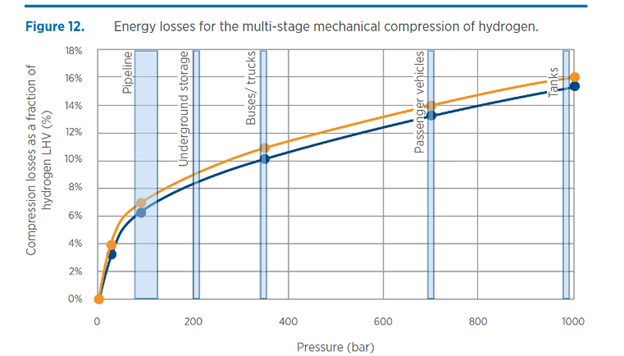
And hydrogen doesn’t compress itself. The work of compression is related to the number of moles of gas, not its mass. The result is that it takes about 3x as much energy to compress a joule’s worth of hydrogen as to compress a joule’s worth of methane by the same amount (the same compression ratio).
Source: IRENA (2020), Green Hydrogen Cost Reduction: Scaling up Electrolysers to Meet the 1.5°C Climate Goal, Figure 12.
It’s important to note, however, that compressors don’t run on heat- they require mechanical energy, i.e. thermodynamic work, i.e. exergy.
Note that electrolyzers produce hydrogen at some pressure, typically 30 to 70 bar for water electrolyzers depending on type. SOECs, not so much- they are quite limited in maximum pressure.
Taking an industrial hydrogen storage pressure of 200 bar for reference, which also happens to be about the maximum pressure which would be expected in a deep underground salt cavern, we can conclude that compression would be require about 8% of the LHV of hydrogen, or about 2.7 kWh of electricity. That doesn’t sound so bad, does it?
Astute readers will realize that gas compression can also be used to store energy. And since all electricity generation units taking hydrogen as a feed, operate near atmospheric pressure, one could install an expander on the hydrogen coming back out of storage to recover some electricity via the work of expansion. In theory, one might be able to recover 1 kWh/kg of the 2.7 or so upon expansion of each kg from 200 bar back to 1 bar. In practice however, the cost of turboexpanders is so high that they are rarely justified as an energy recovery scheme, especially when used intermittently as would be the case for long duration storage.
Furthermore, unless the storage is co-located with the electricity production plant, transmission of the gas from storage to the generator would happen at an intermediate pressure, making it necessary to install two separate expanders- something that simply would never make sense economically.
A couple more problems with hydrogen storage though:
- Aboveground storage is extremely expensive. Pressure vessels for hydrogen don’t come cheap. And sadly, the maximum practical wall thickness for metal vessels, combined with a desire to modularize storage for safety, limits the maximum vertical scale of each container. The result is that containers are numbered up rather than scaled up beyond a certain maximum size. And the result of numbering up rather than scaling up, is that the marginal capital cost (the cost in $ of capital per kg of H2 stored) is structurally high
- You can’t put hydrogen into the depleted gas reservoirs we use to store most of our natural gas. These reservoirs are not guaranteed to be “tight” to hydrogen, and will contaminate the gas coming back out of storage
- If you want to store hydrogen underground, therefore, you’ll need new, bespoke salt caverns to be constructed. Such caverns need to be excavated using enormous quantities of water, resulting in enormous quantities of saltwater needing disposal
- Those caverns aren’t going to be conveniently located where you want to produce your green hydrogen, or where you want to use your hydrogen to make power again.
- No hydrogen distribution network exists to carry hydrogen from where it’s produced to where it will be stored again, nor to carry the hydrogen to where it’s needed
- And while you CAN repurpose existing gas networks to carry some quantity of hydrogen safely, the costs of doing so are extreme, and the amounts of hydrogen which can be safely and economically carried are also extremely limited
- Such networks will consume additional energy due to frictional loss
https://www.linkedin.com/pulse/can-you-put-h2-gas-pipelines-ya-paul-martin-01h4c
And let’s not even talk about liquid hydrogen. Ultracryogenic liquid hydrogen is so insanely energy and especially exergy inefficient that it barely makes sense as a fuel for the upper stages of rockets. Long term storage of liquid hydrogen is simply out of the question due to boil-off.
https://www.linkedin.com/pulse/why-liquid-hydrogen-dumbass-paul-martin-vhbfc
So while the putative cost of storing a kilogram of hydrogen in an underground salt cavern may seem quite low, especially if you then foolishly pretend that 1 kg of H2 is WORTH 33.3 kWh of electricity (which isn’t true- see the next section), the real system-level costs and practicality of such an energy storage system are rather brutal.
Generating Electricity Again
Hydrogen, when wasted as a fuel, shares the same limitation with all other fuels: it is a proxy for heat energy, not thermodynamic work. And while an ideal fuelcell could, in theory, convert 1 kg or 33.3 kWh of LHV worth of hydrogen into 33.3 kWh of electricity with only water vapour as a product, real systems aren’t ideal.
Real PEM hydrogen fuelcell systems that you can buy, tend to be about 50% LHV efficient. Like all real devices for converting chemical energy into work, their efficiency depends on many factors. They do however generate electricity with only water as a byproduct. Sadly, they are also expensive in the extreme, due to their reliance on platinum group metals as catalysts. They also degrade with time and use, just like batteries and electrolyzers. Finally, they require extremely pure hydrogen, with total concentrations of CO + CO2 of less than 10 ppm. That puts limits on what sort of hydrogen you can use, and how you can store it too.
Hydrogen can also be fed to combined cycle gas+steam turbine power plants, which are known to have a maximum efficiency of about 60% on an LHV basis. Such plants are intended for continuous operation rather than generating peaking power. A typical single cycle gas turbine, such as might be used to generate peaking power, has a lower efficiency (35-40% LHV) in return for a lower capital cost.
And whereas the fuelcell will generate only water as a product, both kinds of gas turbines- and all other combustion type engines- will also generate NOx by reaction of nitrogen and oxygen in the combustion air. NOx may be controlled by selective catalytic reduction (SCR) pollution control equipment, but because the reductant required to do so is also always an environmental contaminant or has a global warming potential, NOx concentrations cannot be driven to zero in the effluent by over-dosing the reductant. The result is toxic emissions that simply cannot be completely eliminated.
Round Trip Efficiency
I usually summarize such efficiency chains simply by taking the best practical case.
Given that typical water electrolysis systems consume 55 kWh/kg, and best in class electrolyzers still not commercially available are on the order of 47 kWh/kg on the system level, I generally take 47 kWh/kg or 70% LHV efficiency for electrolysis.
In the interest of simplicity, I take the total of distribution and storage to be about 90% efficient best case.
And I take 60% LHV efficiency as either a very low current density, very expensive fuelcell, or a combined cycle gas turbine power plant, for the power generation portion.
70% x 90% x 60% = 37%, best case. Another way to put this is “buy 3 about kWh, get 1 back”.
More realistically, we might take 55 kWh or 60% LHV efficiency for electrolysis, 85% for storage and distribution (better matching the amount of gas transmission that would actually be required to avoid building electrical grid infrastructure to move electricity instead), and 40% efficiency for a simple cycle gas turbine: 60% x 85% x 40% = 20% round trip efficiency, i.e. buy 5 kWh, get one back.
But let’s be clear: for long term energy storage, energy efficiency doesn’t matter much, because the whole idea is that you’re using “free” or even “negatively priced” electricity. Five times zero is still zero, isn’t it?
Sadly, the deal killer for this simple idea isn’t energy or even exergy efficiency.
Capital Efficiency
As my article about batteries makes clear, all energy storage schemes suffer from the same problem: as you drop the number of cycles, even if you increase the size of the cycle, the capital cost and other operating and maintenance costs of the scheme are spread over fewer kWh, making each returned kWh more expensive.
Low exergy efficiency makes this worse, unless the feed electricity truly is free, which necessitates enormous “charging” power (kW, not kWh) waiting around most of the time doing nothing, but then available to absorb, convert and store electricity when it is cheap or free. And by definition, that means most of the time, that capital will be doing nothing of value.
Low exergy efficiency hurts in another way: since most of the losses of in the hydrogen efficiency chain are on the way out of storage, the storage medium contains a lot less exergy than you think it does. Even best case, 1 kg of H2 compressed and stored in a salt cavern, will only give you back 33.3 x 0.6 = 20 kWh of electricity out of the generation asset. Many times, the people doing the estimates of costs of energy storage, fail to take that into account.
We already know from basic calculations and a knowledge of the underlying engineering fundamentals- borne out by market reality- that hydrogen electrolysis plants a) aren’t cheap b) aren’t getting cheaper in the way batteries and solar did c) cannot get cheap enough to make hydrogen an attractive fuel, basically ever and d) represents a high cost per tonne of CO2e emissions averted even when used for no regret chemical uses.
https://www.linkedin.com/pulse/scaling-lesson-2-water-electrolysis-paul-martin
https://www.linkedin.com/pulse/where-does-green-hydrogen-fit-paul-martin-oc8ac
Green hydrogen’s fundamental economic dichotomy is as follows:
- Electricity that is cheap, is intermittent- with very rare and limited exceptions
- Cheap green hydrogen requires cheap electricity
- Cheap green hydrogen therefore must be produced intermittently,
- Electrolysis plants are expensive, structurally
- Expensive assets used intermittently, have poor capital capacity factors, and hence make expensive products due to high capital intensity per unit of value generated (i.e. per kg of hydrogen)
- You can drive up the capacity factor of the electrolyzer by over-sizing the wind or solar resource dedicated to supply it, but this results in higher costs for each kWh of electricity, making the hydrogen more expensive. And wasn’t the whole plan to avoid curtailing the wind/solar resource?
Hydrogen made at low capacity factor therefore uses hydrogen generation capital assets inefficiently, resulting in expensive hydrogen- even when the electricity used to feed them is cheap or even free.
And electricity made from expensive hydrogen can NEVER be cheap.
Even in the best use of green hydrogen that I can imagine, this capital utilization problem remains pretty much an economic deal killer, requiring structural, permanent subsidy and other public policy measures to drive its adoption.
Even if we were to build electrolyzers in places with anticorrelated wind and sun to obtain high capacity factors, which are also at least 1000 km and preferably more from anyone who needs electricity (making HVDC cables an uneconomic alternative), and use that hydrogen to make a transportable product (ammonia for fertilizer), the end result- even when such projects are done at a scale of many GW- is expensive fertilizer. Make the projects smaller, or operate them on lower capacity factor wind/sun resources, and costs rapidly go through the roof.
The cost per tonne of CO2e emissions averted is also very high, even in best case applications where hydrogen is used for no-regret uses as a chemical.
Take for example a capital cost of $2 million USD/MW of electrolysis plant including balance of plant- which is an underestimate even at giant scale. Assume a project life of 20 years. Such an electrolyzer fed FREE electricity at 100% capacity factor, but with a non-electricity O&M cost of 10% or $200,000/yr and a stack replacement of $500,000 every 50,000 hours, even at a discount rate of zero (i.e. capital provided by an interest free loan from government), the project generates hydrogen costing $2.35 USD/kg.
Fed to a storage system costing nothing, and a power plant costing nothing, that’s $0.14/kWh of electricity returned from storage.
Apply realistic capacity factors to match the entire output of wind or solar assets, even assuming that these assets generate free power, and the capital cost alone for the electrolysis equipment means that the hydrogen produced will be too expensive to make sense to turn back into electricity. The same capital gets spread over too few returned kWh to make it sensible.
Assume capacity factors associated with long duration storage, i.e. using only summer excess solar or surplus wind, and the cost of hydrogen and hence returned kWh, spallates to absurd levels.
And that’s before even considering the cost of the storage system, or the fuelcell or power plant which itself will be used intermittently by the very nature of long-term storage.
As a Texan would say, “that dawg don’t hunt!”
The idea is a turd. Fundamentally.
Attempts to Juggle Turds, or to Polish the Turd
Numerous attempts are made to take this idea, which is technically feasible (without any new inventions required) and conceptually simple, and turn it into something that isn’t a turd in economic terms.
The most obvious one is to try to get better capacity factor out of the assets, particularly the electrolyzer, by using them more often than just for storage. In this variant, the electrolyzer runs on the best combination of wind and sun available, or at least that people will believe, cobbled together out of power purchase agreements, and serves some possibly beneficial use- replacing black hydrogen for ammonia production for fertilizer, for instance. Instead of using the entire output of the electrolyzer for storage, you simply over-size it a bit and run it at higher output in summer, ramping it down to match renewable power availability in winter and shutting it off completely during dunkelflaute when the wind and sun fail to cooperate. The extra hydrogen is stored, and then fed to an existing gas fired power plant in winter as a co-feed- to some small percentage, so you don’t need to modify the existing plant.
It all sounds wonderful, until you realize that somebody has to be willing to pay for expensive food to pay for expensive fertilizer, at a high cost per tonne of CO2e emissions averted, in order to prop up the scheme. The resulting costs of hydrogen remain high, and its value in feeding an ammonia plant that you would otherwise have to shut down or operate at a lower throughput, is higher than its value converted back to electricity again- even during dunkelflaute. And even this scheme drops dead if the power plant has to be bespoke new, built to be capable of feeding it pure hydrogen to eliminate GHG emissions.
The other is to make hydrogen where it can be made cheaply (from high capacity factor wind + sun), make it into something which, unlike hydrogen, you can ship, store that, and then burn that in power plants. That idea stinks to high heaven, because it drives up both capital cost (by adding new steps, requiring yet more capital equipment) and by making exergy efficiency even worse.
https://www.linkedin.com/pulse/wind-ammonia-good-bad-ugly-paul-martin-set3c
The reality here is that hydrogen’s capex requirements as an energy storage medium are just too high to ever justify using it for long term energy storage- even if somebody else is paying most of the freight, so to speak, by buying expensive food made with expensive fertilizer. And let’s just not even get started talking about wasting hydrogen as a natural gas replacement in fired equipment to make industrial heat, or as a transport fuel etc. Those ideas have been bludgeoned to death in my other articles anyway. For those who want the summary, with links to each article on each topic, here it is:
https://www.linkedin.com/pulse/distilled-thoughts-hydrogen-paul-martin
What Should We Do Instead?
My most important article covers the whole energy transition strategically at a high level.
https://www.linkedin.com/feed/update/urn:li:activity:6746179919799300096
And my article about batteries for grid storage (link already provided) spells it out in even more detail: long term energy storage is really about emergency response and supply resilience. It’s a UPS, not a power plant. Accordingly, it needs the following things:
- Reliability- if it ain’t nearly 100%, it’s worthless
- Low capex- preferably capex that has already been expended and fully amortized
- Such assets are best paid for out of the public purse, because the benefit is public and the public purse has the lowest borrowing cost
- Energy efficiency and fuel cost are both secondary, but nice to have along with 1-3 above
Accordingly, I think we should use the natural gas infrastructure – the transmission, storage and generation infrastructure, scrapping most of the distribution infrastructure- for emergency response and to provide dunkelflaute coverage. Its alternative is to be scrapped anyway, so all we’ll need to pay is maintenance costs. And once we’ve gotten GHG emissions down to the point where we’re using fossils to provide only 5%-ish of our energy needs, we’ve already got the global warming problem more or less licked.
We could store up a year’s worth of biogas methane and drop that 5% to ~ 0%. That would cost a bit more, and there are other potential consumers of that biogas, in the form of industrial applications like cement clinkering which need fire rather than merely heat. But even that would be cheaper, by a long shot, than messing about with wasting hydrogen as an energy storage medium.
Let’s not kid ourselves: anything we reserve for use only 5% of the time, is going to cost a fortune. It’s expensive insurance. We’ll still need to do all the other things my article talks about- overbuilding wind and solar for winter demand, short term storage, wider grids, smarter demand management etc., with the option to build some nuclear if you think you can afford it locally. We’ll all need to take a cold, dark holiday during those times of the year, conserving expensive kWh to meet our true needs, not our whims and wishes. But it’s very, very far from impossible.
And hydrogen has basically no part in it.
Disclaimer: this article was written by a human, without the aid of artificial plagiarism software. Humans are known to screw up from time to time. Where I’ve done so, let me know with good references and I’ll be happy to correct both my work and my mindset.
If however what you don’t like is that I’ve taken a dump on your pet idea, reach out to my employer Spitfire Research Inc. who will be very happy to tell you to piss off and write your own article.